

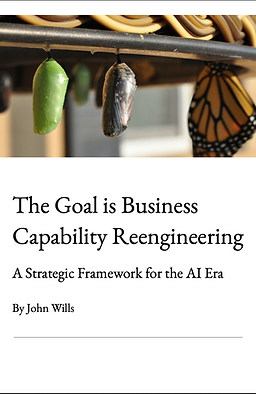
The Goal is Business Capability Reengineering
A Strategic Framework for the AI Era
A strategic framework for enterprise leaders navigating the transformation from application-centric to capability-centric operations
Why this Book Exists
Most enterprise operating models were designed for an era before:
-
AI agents that can execute business processes end-to-end
-
Conversational interfaces replacing traditional applications
-
Capability flows replacing rigid workflows
-
Machine-to-machine operations at enterprise scale
As a result, many organizations today are adding AI to outdated structures, layering copilots onto legacy applications, and struggling to envision what the transformed enterprise actually looks like.
The Goal is Business Capability Reengineering was written to give enterprise leaders a strategic map for navigating a transformation that will unfold over the next decade—and to help them understand what their organization becomes when AI agents perform the work.
What "Capability Reengineering" Really Means
Capability reengineering does not mean:
-
Replacing humans with AI
-
Building cheaper custom applications
-
Automating existing processes as-is
It means:
-
Shifting from application-centric to capability-centric design
-
Enabling AI agents to execute business capabilities within policy-defined boundaries
-
Redefining human roles from doers to supervisors and exception handlers
-
Architecting for autonomous operations with human accountability
The goal is not automation for its own sake, but enterprise agility, efficiency, and resilience at scale.
Who the Book Is For
The book is written for:
-
CIOs, CDOs, CTOs, and enterprise technology leaders
-
Leaders preparing their organizations for agentic AI
-
Enterprise architects designing for AI-native operations
-
Business leaders responsible for transformation strategy
-
Executives evaluating SaaS, platform, and build-vs-buy decisions
If your organization is trying to understand how AI will reshape not just tools but the entire operating model, this book is for you.
What the Book Covers
The book focuses on the strategic realities of enterprise transformation in the AI era, including:
-
The AI Modernization Cycle: four phases over 10-15 years, from augmentation to autonomy
-
Modern Business Architecture: a nine-layer framework for the target-state enterprise
-
Capability Applications and Capability Flows: the new paradigm replacing traditional applications
-
How roles and responsibilities evolve as AI takes on execution
-
Governance structures for agent-centric operations
-
Strategic implications for SaaS vendors, platform companies, and consulting firms
-
Detailed transformation examples across business domains
The emphasis throughout is on where enterprise architecture and operations are headed—not frameworks for their own sake.
How the Book Is Different
This is not a technology implementation guide, nor an AI tutorial. It is not a vendor evaluation framework. It is not an academic exercise.
It is grounded in real enterprise experience across decades of data platforms, consulting practices, startups, and executive advisory work—and picks up where The Goal is Autonomous Governance left off.
The book is designed to:
-
Be read by executives, not just architects and practitioners
-
Provide the strategic frameworks leaders need to plan and lead transformation
-
Establish a shared vocabulary for communicating target-state objectives across the organization
How Leaders Use the Book
Leaders can use this book to:
-
Understand the timeline and phases of AI-driven enterprise transformation
-
Inform strategic planning for technology investments and organizational design
-
Evaluate build, buy, or outsource decisions for business capabilities
-
Prepare governance frameworks for agentic operations
-
Align stakeholders around a common vision of the transformed enterprise
-
Drive cross-functional conversations about roles, policies, and accountability
Related Thought Leadership
-
TDAN Column: Crossing the Data Divide
-
Thought Leadership Hub: Articles and executive papers on data, metadata, governance, and AI